Mi ha fatto tanto ridere che hai posto nella nostra camera un letto da una piazza e mezzo
It made me laugh so much that you put a one-and-a-half bed in our room
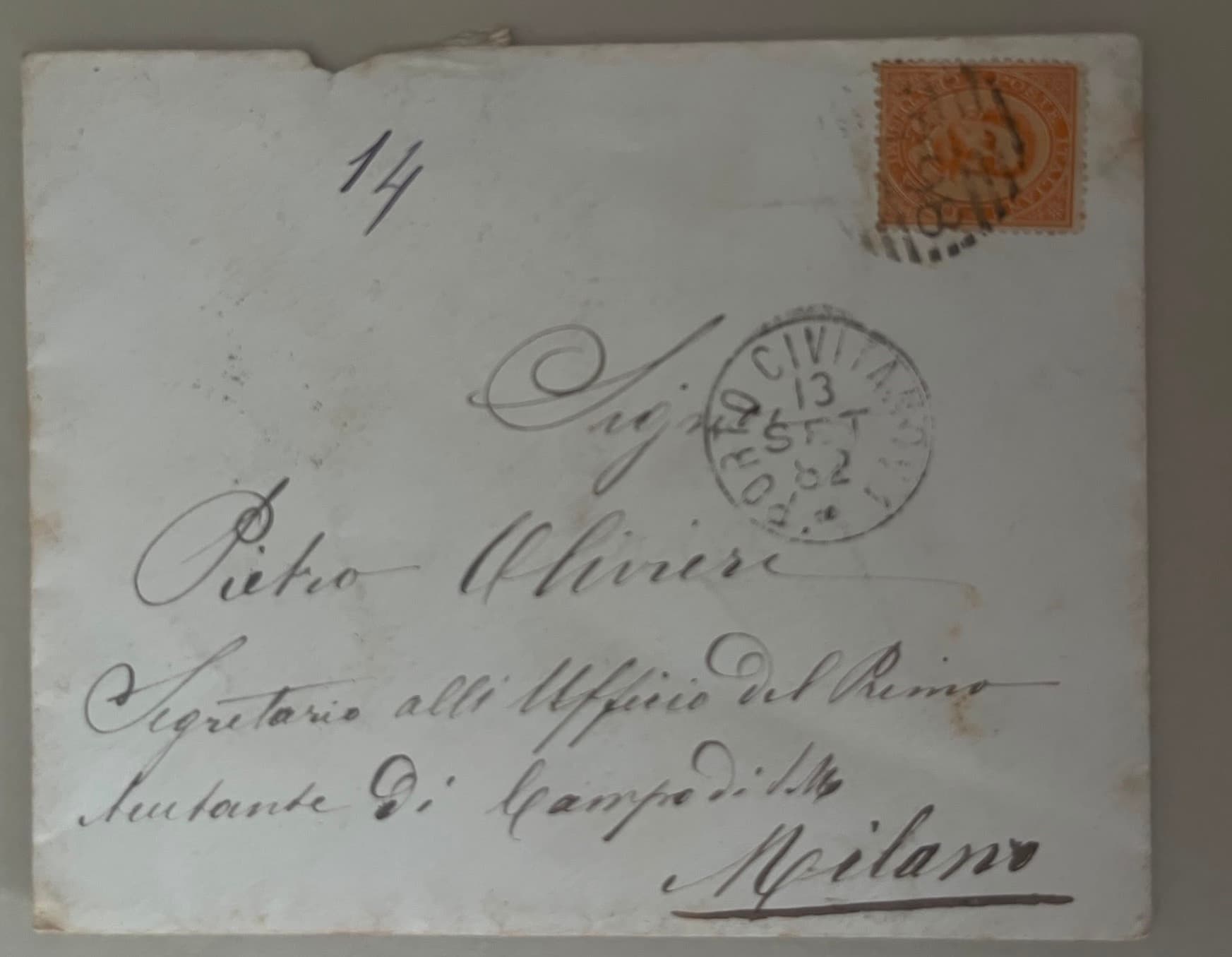
The letter
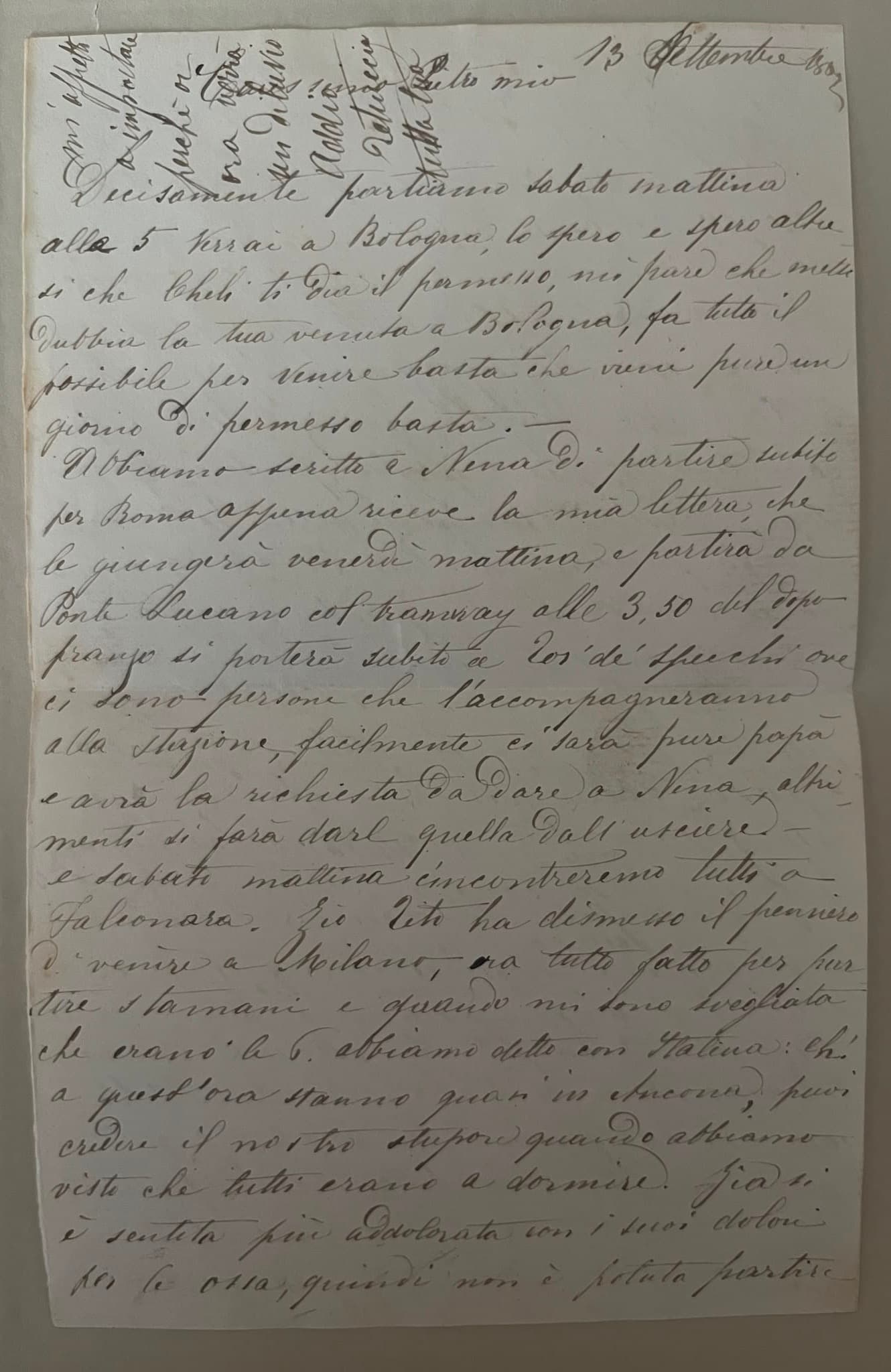
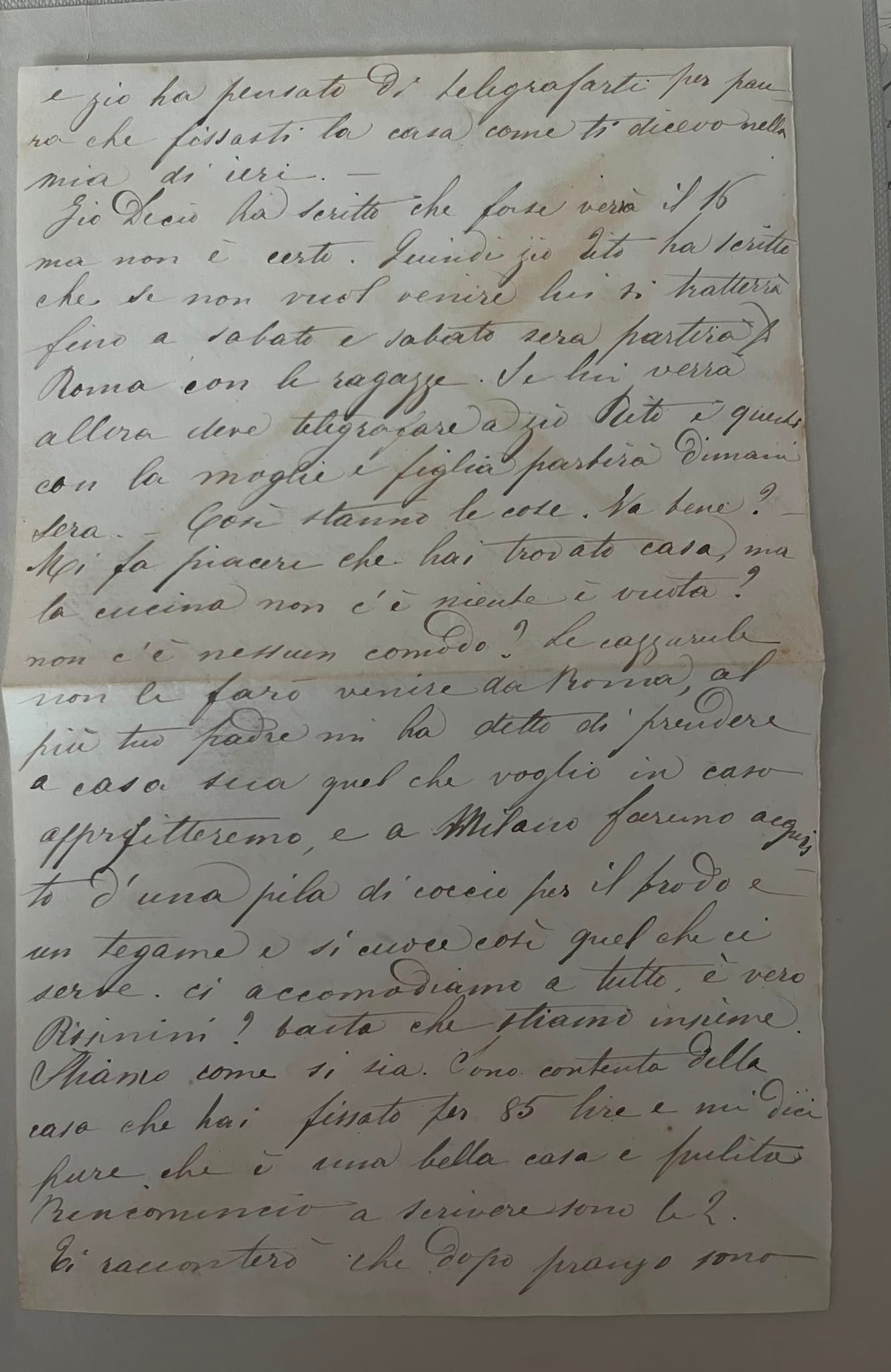
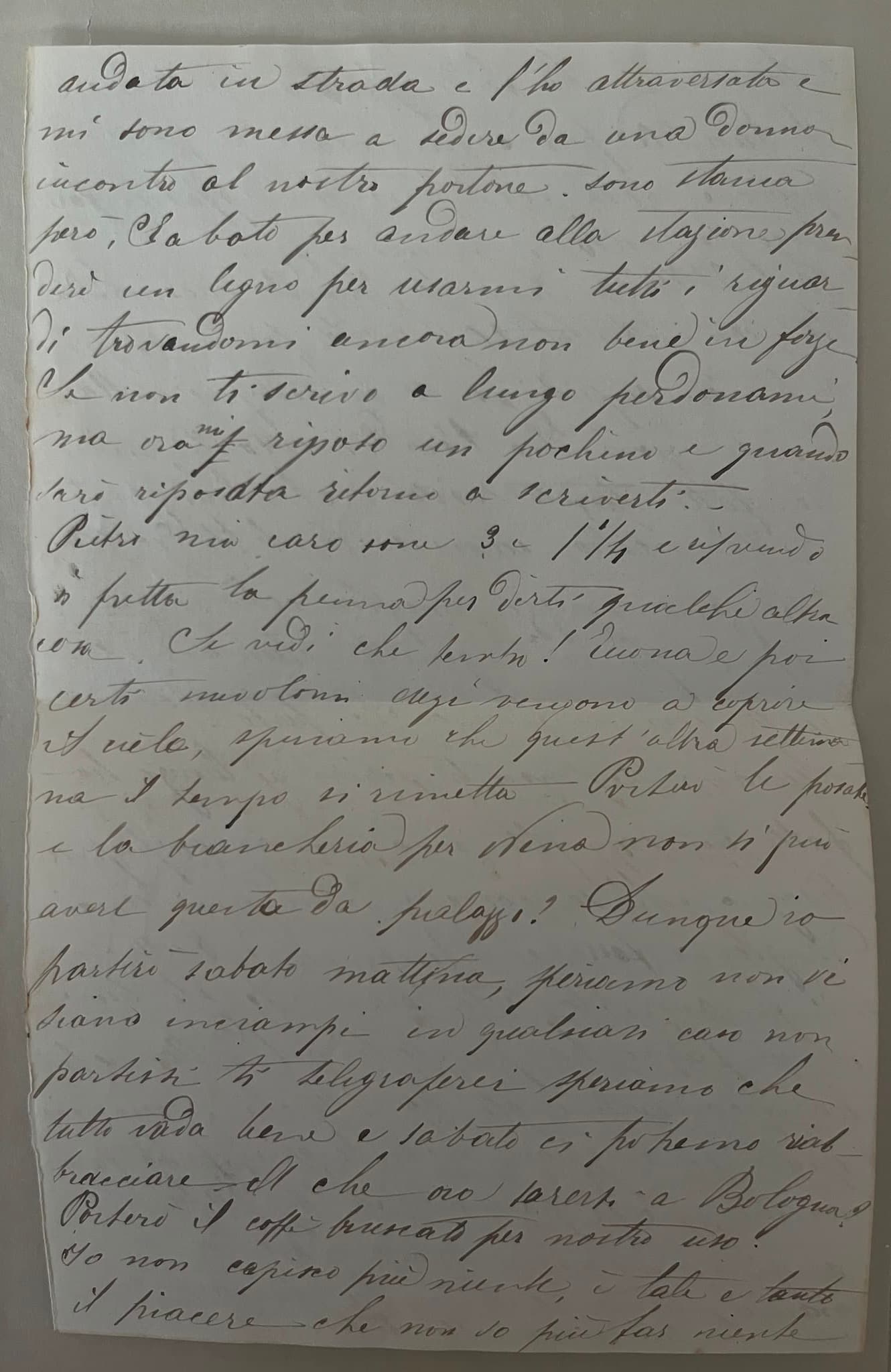
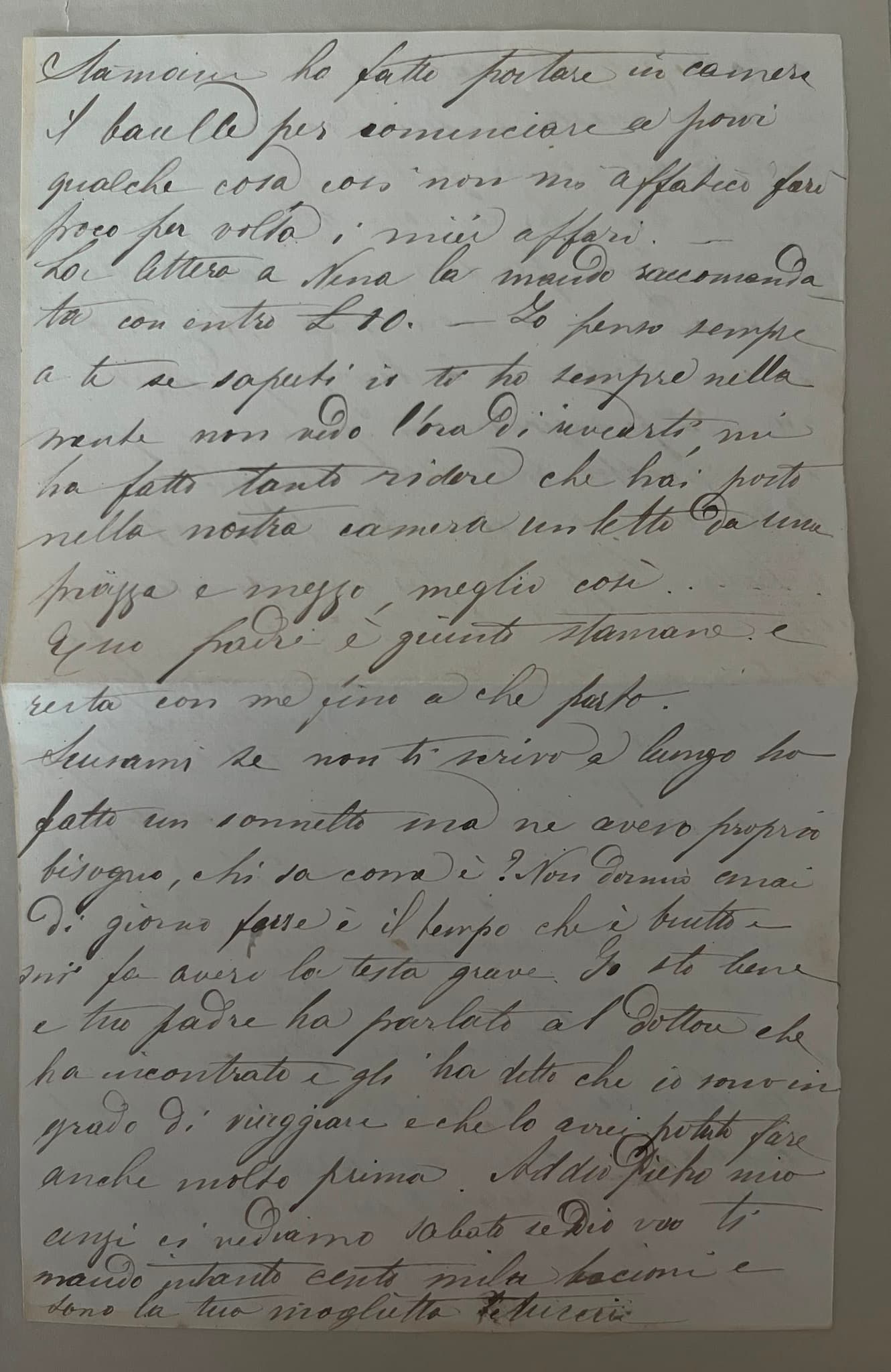
13 September 1882
My dearest Pietro,
we are definitely leaving Saturday morning at 5. You will come to Bologna, I hope, and I hope too that Cheli gives you leave; it seems to me he casts doubt on your coming to Bologna. Do everything you can to come; it is enough if you come even on one day's leave, enough.
We have written to Nena to leave for Rome as soon as she receives my letter, which will reach her Friday morning, and she will leave Ponte Lucano by the tramway at 3.50 in the afternoon; she will go straight to Tor de' Specchi, where there are people who will easily take her to the station, and papà will be there too and will have the request to give to Nena, otherwise she will have herself given the one from the usher. And Saturday morning we shall all meet at Falconara.
Uncle Tito has given up the idea of coming to Milan; everything was ready for leaving this morning, and when I woke up, at 6, Italina and I said: «Who knows, by now they must be nearly in Ancona»; you can imagine our astonishment when we saw that everyone was asleep. He had been feeling worse, with his pains in the bones, so he could not leave.
And he has already thought of telegraphing you, for fear you would fix the house, as I told you in yesterday's letter.
Uncle Decio has written that he may come on the 16th, but it is not certain. So uncle Tito has written that if he will not come, he will stay until Saturday and on Saturday evening leave for Rome with the girls. If he does come, then he must telegraph uncle Tito, and he, with his wife and daughter, will leave tomorrow evening. That is how things stand. All right?
I am glad you have found a house, but the kitchen, is there nothing in it, is it empty? No convenience at all? The pots I will not have sent from Rome; at most, your father told me to take from his house whatever I want. At home we shall rent what we need, and in Milan we shall buy an earthenware pot for the broth and a pan, and that way we cook what we need. We adapt to anything. Isn't that so, Ririnini? As long as we are together. We shall manage however it is.
I am happy about the house you have taken for 85 lire, and you tell me too that it is a fine house and clean.
I am starting to write again, it is 2 o'clock.
I will tell you that after lunch I went out into the street and crossed it and sat down at a woman's, opposite our front door. I am tired, though. On Saturday, to go to the station, I will take a carriage, to spare myself in every way, as I am still not quite strong. Forgive me if I do not write at length, but now I will rest a little, and when I am rested I will come back to writing to you.
My dear Pietro, it is a quarter past 3 and I take up the pen again in haste to tell you a few more things. If you saw what weather! It is thundering, and great clouds are surely coming to cover the sky; let us hope next week the weather settles.
I will bring the cutlery and the linen for Nena. Can one not have that from the palace?
So I shall leave Saturday morning, let us hope there are no hitches; in any case, should I not leave, I would telegraph you. Let us hope all goes well and on Saturday we can embrace again. Ah, if only I were in Bologna now!
I will bring the roasted coffee for our use! I no longer understand anything, so great is the pleasure that I cannot do anything any more.
This morning I had the trunk brought up to my room, to begin putting a few things in, so that I do not tire myself: to do my things a little at a time.
The letter to Nena I am sending registered, with 40 lire inside.
I think of you always, if you knew; I have you always in my mind, I cannot wait to see you. It made me laugh so much that you put a one-and-a-half bed in our room, better so.
Your father arrived this morning and is staying with me until I leave.
Forgive me if I do not write at length; I had a little nap, but I really needed it. Who knows what it is? I never sleep by day, perhaps it is the weather, which is bad and makes my head heavy.
I am well, and your father spoke to the doctor he met, who told him that I am fit to travel and could have done so even much earlier.
Farewell, my Pietro, or rather, see you Saturday, God willing. Meanwhile I send you a hundred thousand big kisses and am your little wife Tetuccia.
Postscript, crosswise at the head of the first page: «I hurry to post this, because a downpour is about to come. Farewell. Tetuccia. All yours.»
Notes
The King. In September 1882 Umberto I reigns, on the throne since January 1878; the Queen is Margherita. In those days the King is at the great manoeuvres in Umbria, at Perugia and Foligno, with his first aide-de-camp Pasi, then in Florence; the autumn he will spend at Monza, in the Villa Reale his father gave him at his marriage, which since he became king has been the court's residence in the fine season, and in 1882 itself a royal station is built beside it on the new line to Chiasso. Pietro's office follows the King, and he has gone ahead to Milan to prepare the season: that is why he is looking for a house there, and Teresa joins him.
The First Aide-de-Camp to H.M. The officer who stands beside the King as head of the armed forces: he answers for the safety of the palaces and of the sovereign's person, commands the squadron of the Carabinieri Guardie del Re and the liveried staff of the Quirinale, and acts as go-between with the Minister of War for appointments and movements in the Military Household. In 1882 the post changes hands: General Giacomo Medici, who had held it since 1874 and dies in March, is succeeded by Raffaele Pasi, from Faenza, born in 1819, lieutenant general, gold medal for valour at Custoza in 1866, aide-de-camp to the King since 1878; he will keep it until his death in January 1891. The Calendario generale del Regno of that year lines up the office in three lines: «Primo aiut. di campo gen., S.E. Pasi conte Raffaele; Ff. di capo d'uff., Cheli Leopoldo, segretario; Vice segr., Olivieri Pietro».
Cheli. Leopoldo Cheli, secretary and acting head of the office, Pietro's immediate superior. The «leave» depends on him, a day off to go as far as Bologna.
85 lire. The monthly rent of the house in Milan. By ISTAT's coefficients, which track consumer prices since 1861, 85 lire of 1882 are worth about 380 euros of 2020, a little over 4,500 euros a year. It is a conversion that follows prices, not incomes, and against the salaries of the time the sum weighed more. A couple of yardsticks are in the letter itself: the stamp on the envelope cost 20 centesimi, and to Nena, for the journey from Rome to Milan, Teresa sends 40 lire.
The request. In all likelihood the request for reduced-fare rail travel issued through the administration of the Royal Household: that is why «papà», that is Achille Mancini, can obtain it, otherwise «she will have herself given the one from the usher» at the palace.
Sonnetto. She writes «sonnetto», a little nap, not a sonnet; the pun is lost in translation.
Who Pietro and Tetuccia were
It is she who writes, Teresa Mancini, who signs herself Tetuccia and «your little wife». She was born in 1859, the daughter of Achille Mancini, a Roman liberal whom the papal police kept an eye on before 1870: he is the «papà» of the letter, the one who in Rome can obtain the request for the train, and he will be godfather to the first son. Her sisters were Virginia and Italina: the Italina with whom she wakes at six at Porto Civitanova is her sister. Pietro and Teresa married around 1880, and their first child, Costanza, was born at Palombara Sabina on 5 August 1881, a year before the letter. In September 1882 Teresa is «still not quite strong» from something she does not name: it is not the birth of Costanza, who is already a year old.
They will have nine children. After Costanza, all born in Rome: Umberto in 1884, Raimondo in 1885, Virginia in 1887, Guglielmo in 1888, Carlo in 1889, Margherita in 1893, Ottorino in 1895, Massimo in 1898. The family lives in piazza dell'Esquilino, then near San Carlo alle Quattro Fontane and in via Genova, finally in via del Quirinale; summers at Levanto. In July 1928 Teresa is still alive, named as his wife in his death record.
Pietro Olivieri was born at Acqui in 1854, «of a good family», and came to Rome around 1880. In 1882 he is vice-secretary of the Office of the First Aide-de-Camp to H.M., the office of the Royal Household that follows the King on his travels, and in the Royal Household he will remain all his life: Knight of the Crown of Italy in 1891, head of section first class in 1900, honorary director of administration in 1910, grand officer in 1920. He dies in Padua on 5 July 1928, aged seventy-four, «retired colonel» according to those who reported his death.
Of the children, three left a longer trace. Costanza married Giulio Querini in Rome in 1906 and died in Rome in 1969. Umberto had a life out of a novel, printed biography included: a lawyer in Rome, in 1912 he married an American, Agnes Mellen Kent, on Cape Cod; in 1915 he rescued and later adopted a little girl left alone by the Marsica earthquake; an artillery officer in the Great War; then for fourteen years a banker at the Bank of America in San Francisco and for thirty a professor of languages at Santa Clara University; in 1958, aged seventy-four, back in Italy among the Benedictines of Subiaco, he was ordained a priest and spent his last years among the Otomí of the Mezquital valley in Mexico, who called him the padre of the Otomí. He died in 1973. Raimondo, known as Dino, never married and made his whole career in the Royal Household like his father: secretary to Queen Elena, then in the retinue of Umberto II in his exile at Cascais, where in 1976, by then ninety, he was still with the former king. Ottorino, an officer, died unmarried in 1927, a year before his father.
Sources
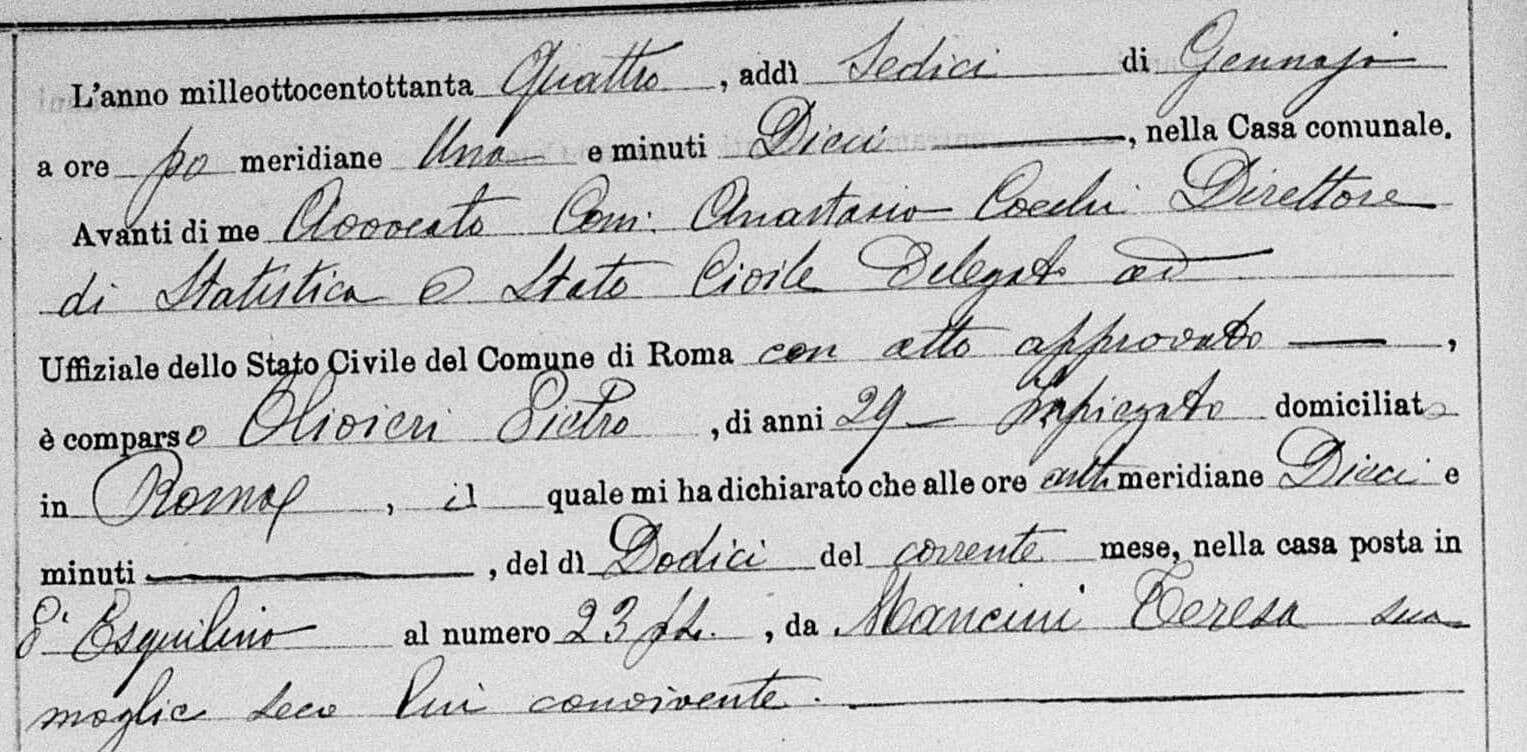
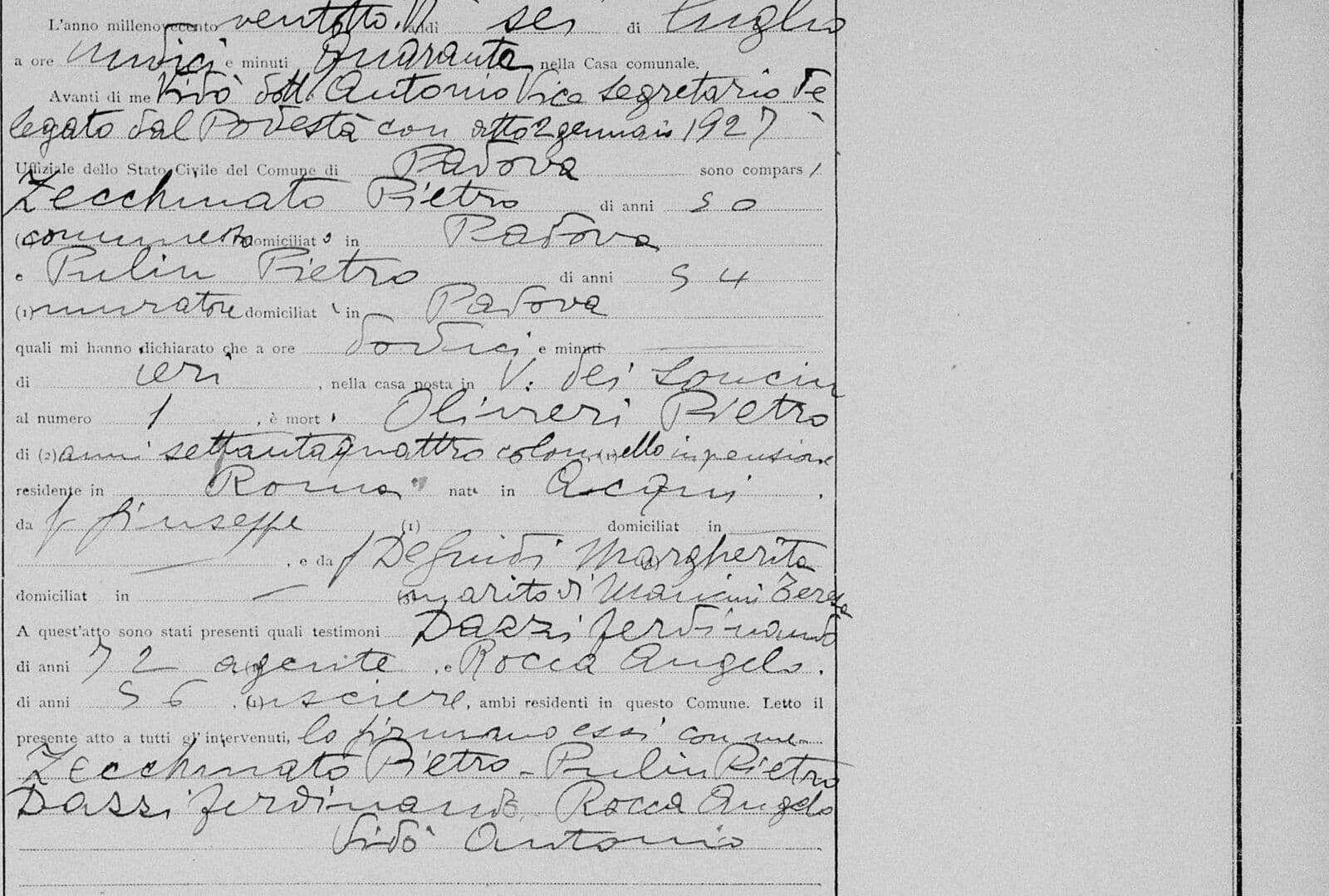
- Calendario generale del Regno d'Italia, 1882, p. 34: «Ufficio del primo aiutante di campo di S.M. — Vice segr., Olivieri Pietro».
- Rome, birth records: Umberto, 1884, series A no. 157; Guglielmo, 1888, series B no. 2553; Massimo, 1898, series C no. 3043 (Archivio di Stato di Roma, Portale Antenati).
- Rome, death record of Ottorino Olivieri, 1927, part I no. 5295.
- Padua, death record of Pietro Olivieri, 5 July 1928, transcribed in Rome, 1928, part II series A no. 122.
- Gazzetta Ufficiale del Regno d'Italia, 6 April 1891, no. 80; 19 April 1901, no. 93; 12 January 1912, no. 9; 1 August 1922, no. 180.
- Il Popolo Romano, 10 January 1890 and December 1891, column «La Real Corte».
- Dizionario biografico degli italiani, entry «Pasi, Raffaele».
- ISTAT, Il valore della moneta in Italia dal 1861 al 2020, information note, 2021: price index 1882 = 0.904 and 2020 = 7,825.756 (base 1913 = 1); 85 × 7,825.756 ⁄ 0.904 ⁄ 1,936.27 ≈ 380.
- Palombara Sabina, birth record of Costanza Olivieri, 5 August 1881, no. 107 (Portale Antenati).
- Rome, marriage record of Giulio Querini and Costanza Olivieri, 5 May 1906, series A no. 951.
- Rome, transcription of the marriage of Umberto Olivieri and Agnes Mellen Kent, celebrated at Orleans, Massachusetts, on 19 August 1912: 1915, part II series B1 no. 69.
- Gazzetta Ufficiale, September 1882, for the King's movements; 22 May 1924 (supplement), 16 May 1934 no. 115 and 18 September 1940 no. 219 (supplement), for Raimondo Olivieri's career in the Royal Household.
- William N. Abeloe, To the Top of the Mountain. The Life of Father Umberto Olivieri, «Padre of the Otomis», Exposition Press, Hicksville (N.Y.) 1976.